HALL OF HONOUR
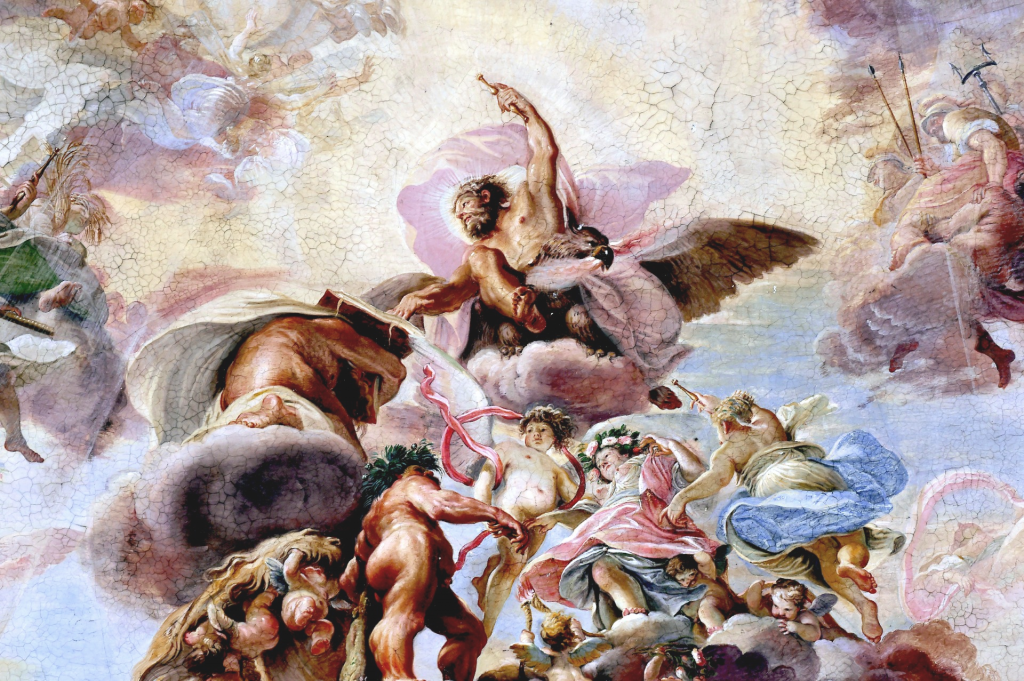
The Salone d’onore [Hall of Honour] was decorated between 1669 and 1671 by Domenico Maria Canuti. After making the two oval paintings for the staircase, Canuti worked with the quadraturist Domenico Santi, known as Mengazzino (Bologna, 1621 -1694) to create the large fresco ofApoteosi di Ercole.
At the center of the vault is a depiction of Ercole [Heracles], the namesake hero of Odoardo’s father and his nephew, as he is welcomed into Olympus by Giove [Jupiter], seated astride an eagle in the presence of Amore [Cupid] and his bride Ebe [Hebe], the goddess of eternal youth. Nearby is Giunone [Juno], with her scepter and crown, while above, amidst the clouds, the gods look on within the dazzling radiance of the Carro del Sole [Chariot of the Sun]; below the hero are several allegorical figures representing virtues and vices: Ragione [Reason] governing Forza [Strength] (symbolized by a wild beast), and Superbia [Pride] andInvidia [Envy], depicted as two women, one young and beautiful, the other old with a greenish complexion—who are plummeting downward. The scene unfolds in an open sky beyond the rich quadratura painted by Mengazzino who, by extending the hall's actual architecture and complicating it with a triumph of feigned elements (cornices, balustrades, arches, niches, columns, and bas-reliefs), creates the illusion of a space expanding into infinity. This illusive architecture is inhabited by telamons supporting the cornices and lively cherubs holding garlands of fruit, while at the four corners, muscular giants in contorted poses draw inspiration from Michelangelo's "ignudi" in the Sistine Chapel. At the center of each side, four gilded monochrome medallions are painted, depicting episodes from the stories of Heracles: The Liberation of Alcestis from Hades, , The Struggle for the Tripod of Delphi, , Heracles and the Cercopes and The Apples of the Hesperides.
At the base of the vault, the black and white checkered coat of arms of the Pepoli—whose bicolor scheme, mirrored in the hall's flooring, alludes to the chessboard used as a professional tool by money-changers—is accompanied by the heraldic insignia of the wives of various family members. It is surmounted by the swan, another Pepoli symbol which, along with the chessboard, recurs with persistent frequency throughout the decoration of the piano nobile. Further complicating the room's interplay between reality and fiction—a characteristic typical of Baroque theatricality—are the metal crowns positioned above the swans, which refer to the title of Count obtained by the branch of the family to which Odoardo belonged.