Parmigianino, towards Mannerism
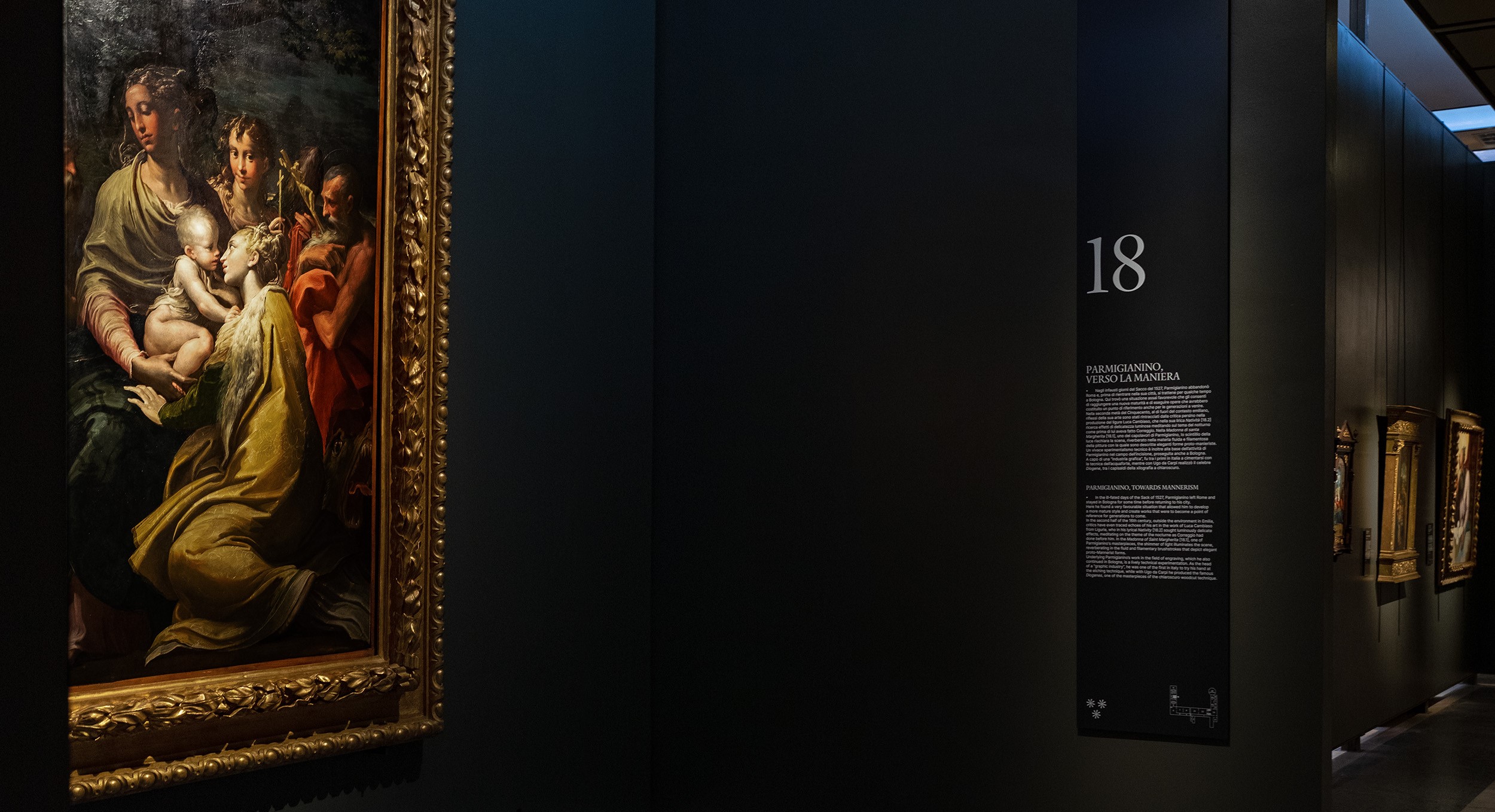
In the ill-fated days of the Sack of 1527, Parmigianino left Rome and
stayed in Bologna for some time before returning to his city.
Here he found a very favourable situation that allowed him to develop
a more mature style and create works that were to become a point of
reference for generations to come.
In the second half of the 16th century, outside the environment in Emilia,
critics have even traced echoes of his art in the work of Luca Cambiaso
from Liguria, who in his lyrical Nativity [18.2] sought luminously delicate
effects, meditating on the theme of the nocturne as Correggio had
done before him. In the Madonna of Saint Margherita [18.1], one of
Parmigianino's masterpieces, the shimmer of light illuminates the scene,
reverberating in the fluid and filamentary brushstrokes that depict elegant
proto-Mannerist forms.
Underlying Parmigianino’s work in the field of engraving, which he also
continued in Bologna, is a lively technical experimentation.
As the head
of a “graphic industry”, he was one of the first in Italy to try his hand at
the etching technique, while with Ugo da Carpi he produced the famous
Diogenes, one of the masterpieces of the chiaroscuro woodcut technique.


